A Definitive Guide to Motorised Two Wheelers

Motorised Two-Wheelers: Vehicle Stance and Uses

A A

Introduction

Vehicle stance refers to the overall posture, proportions, and geometric configuration of a two-wheeler, as well as the rider’s positioning in relation to it. Stance influences stability, comfort, maneuverability, and visual identity. Even without technical expertise, observers can distinguish between an upright commuter motorcycle and a low, forward-leaning sport motorcycle. These visible differences arise from engineering decisions that align with intended function.

For instance, the upright configuration of the Honda CB125F contrasts with the aerodynamic, performance-oriented stance of the Kawasaki Ninja ZX-6R. Each reflects a specific design objective and usage environment.

This article reframes vehicle stance by examining its structural foundations, evolution, technical components, and broader design implications within global and Indian contexts.

Structural Foundations of Stance

Vehicle stance is primarily determined by the interaction between frame geometry and suspension systems. The positioning of the front and rear suspension influences ride height, weight distribution, and steering behavior. Suspension components absorb road irregularities while maintaining tire contact with the surface, directly affecting both stability and rider comfort.

elementor-placeholder-image
Lorem Ipsum
elementor-placeholder-image
Lorem Ipsum

The front suspension, typically using telescopic forks, influences steering response and braking stability. The rear suspension, often incorporating swingarm-based shock absorbers, contributes to traction and load support. Together, these systems define how the vehicle maintains balance under acceleration, braking, and cornering.

Understanding these structural elements provides insight into how stance is engineered rather than merely styled.

Evolution of Two-Wheeler Stance

Historically, early motorcycles adopted bicycle-derived geometries, characterized by upright seating and minimal suspension travel. As engine performance increased and riding purposes diversified, stance evolved to accommodate new demands.
Cruiser motorcycles developed extended wheelbases and relaxed ergonomics suited for long-distance highway travel. Sport motorcycles adopted steeper steering angles and aggressive rider triangles influenced by racing. Adventure motorcycles introduced taller suspension systems to address varied terrain.
This historical progression demonstrates how changes in infrastructure, performance expectations, and user behavior reshaped vehicle stance over time.

Key Mechanical Components Influencing Stance

Several mechanical elements collectively shape stance.

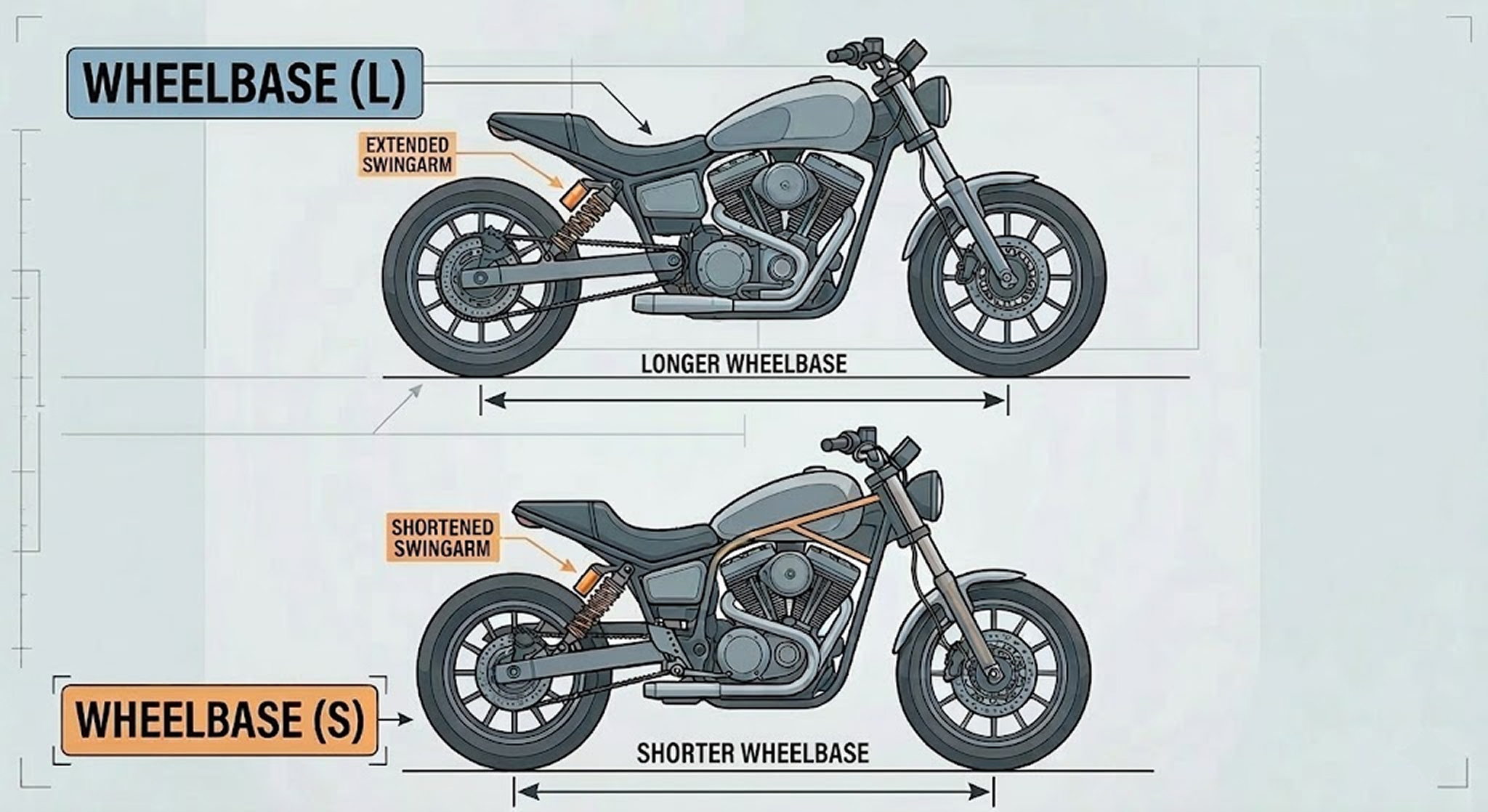
WHEELBASE

The wheelbase determines longitudinal stability. A longer wheelbase generally enhances high-speed balance, while a shorter wheelbase improves manoeuvrability in dense urban environments. 

Diff. between a long and short wheelbase.
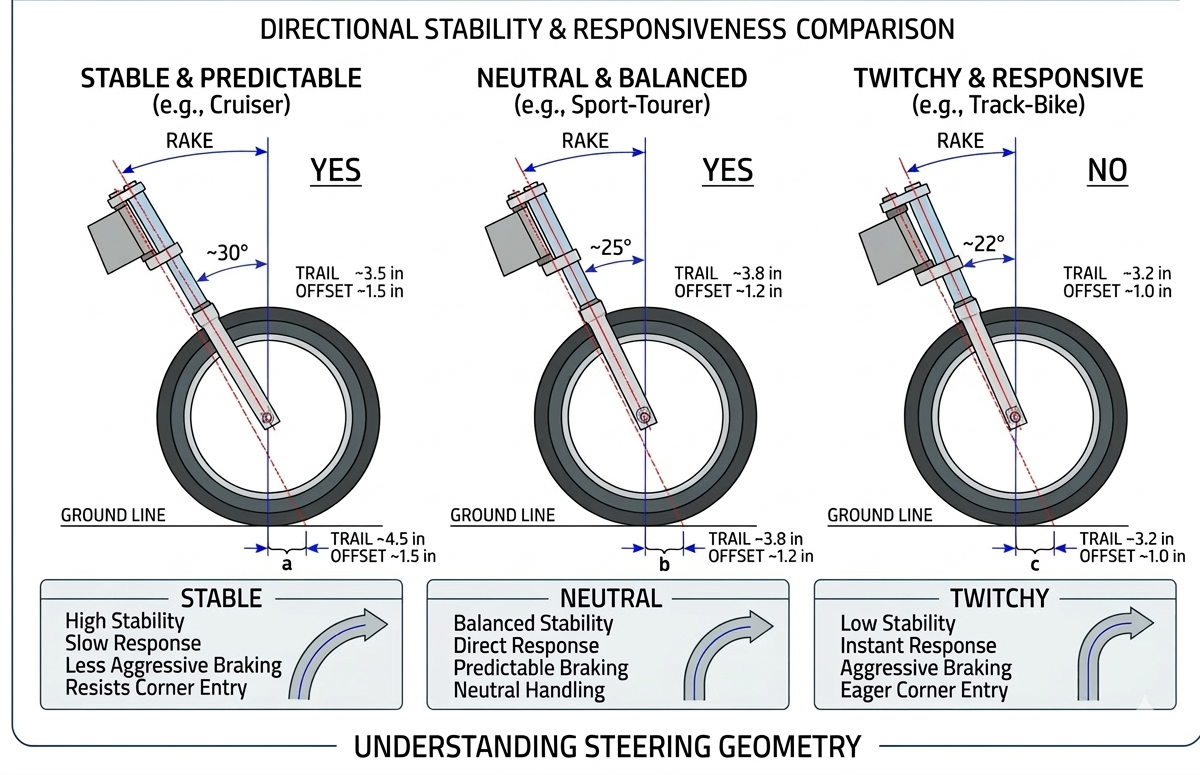
STEERING GEOMETRY

Steering geometry, including rake and trail, affects directional stability and responsiveness. Adjustments to these parameters alter how the motorcycle behaves during cornering and braking.

Image description
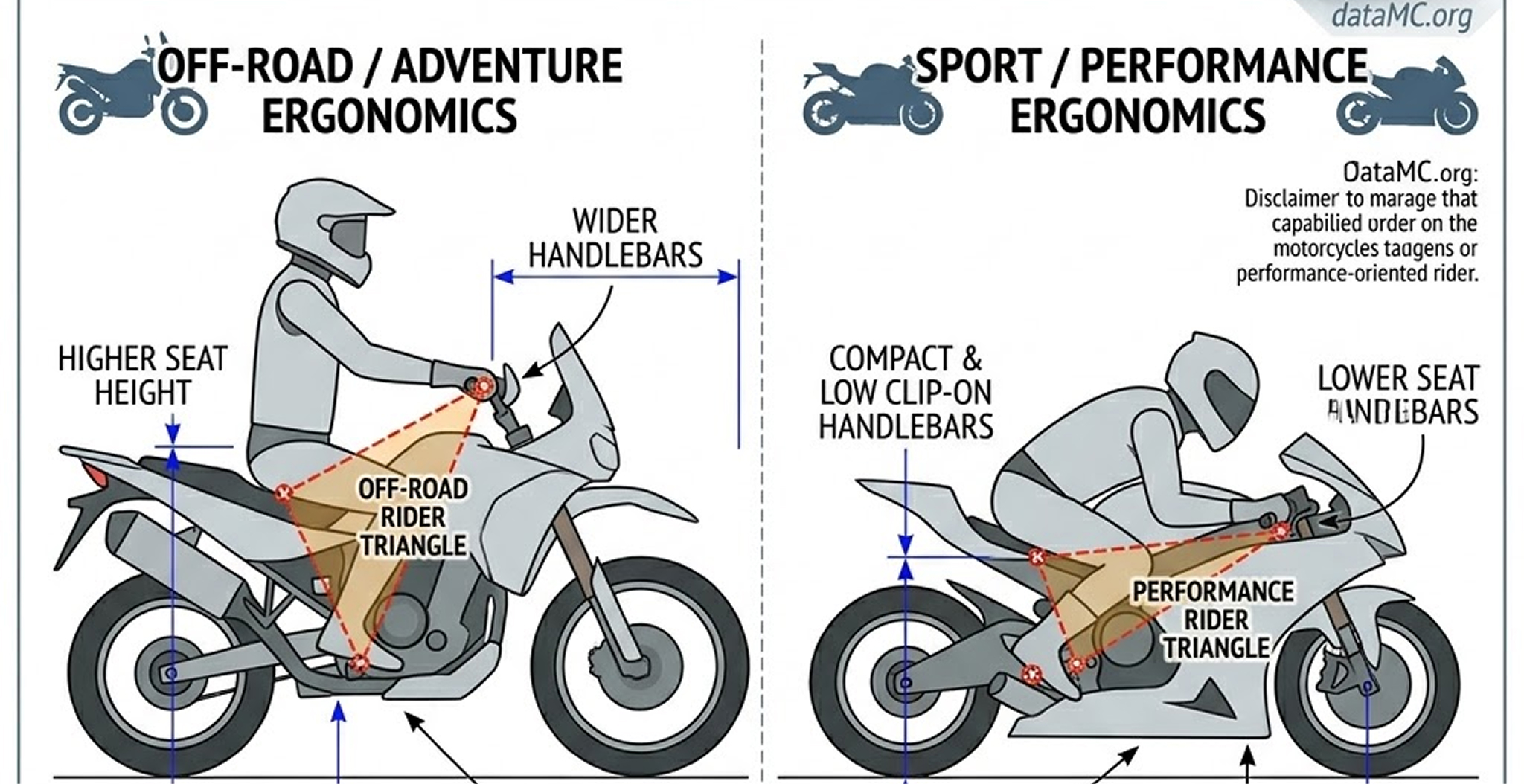
SEAT HEIGHT & RIDER TRIANGLE

Seat height and rider triangle define ergonomic interaction. Higher seats and wider handlebars often indicate off-road capability, while lower seats and rear-set footpegs suggest performance-oriented riding.

Image description
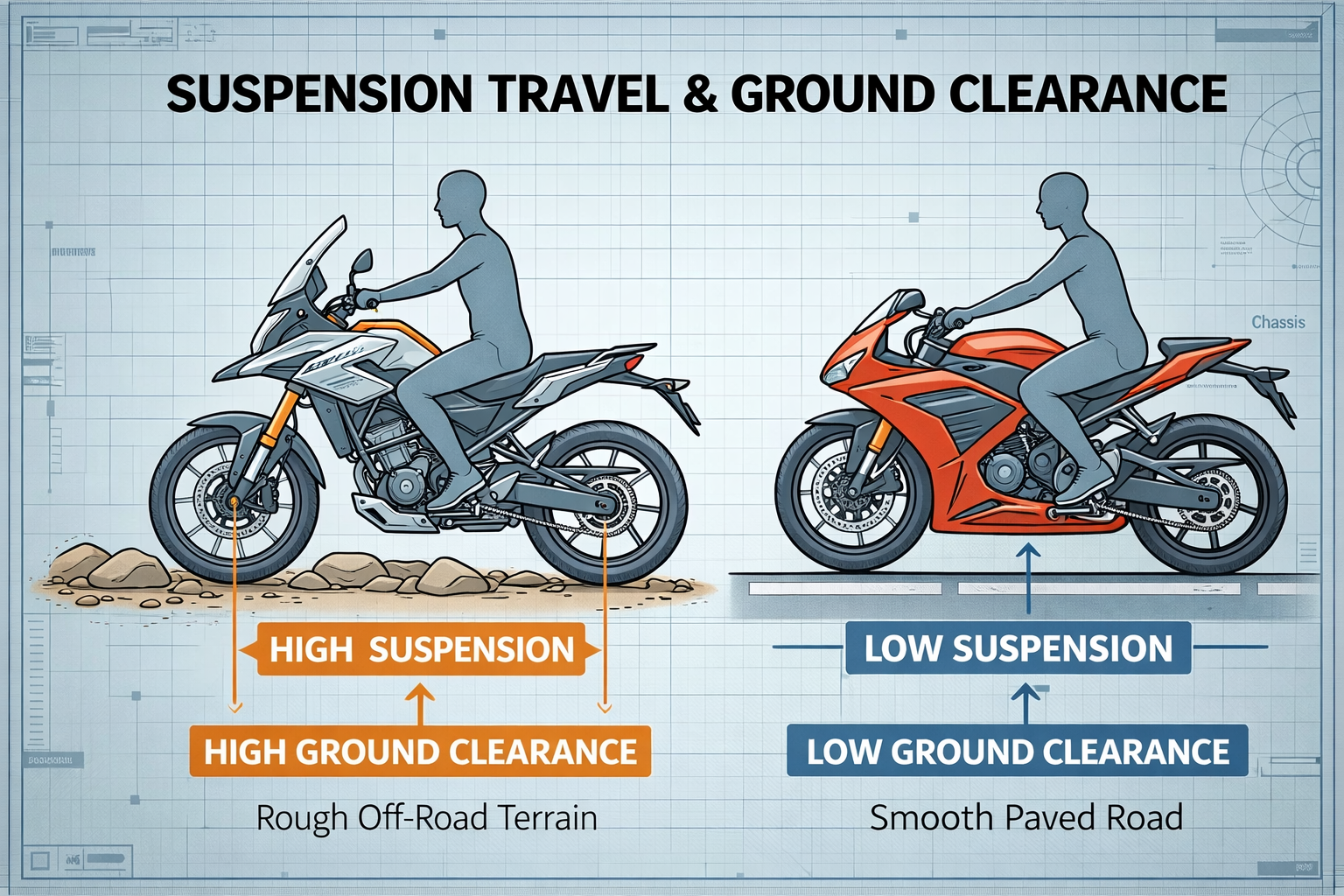
SUSPENSION TRAVEL & GROUND CLEARANCE

Suspension travel and ground clearance influence how a motorcycle responds to uneven surfaces. Taller suspension systems accommodate rough terrain, whereas lower setups optimize road-focused performance

Image description

These components operate as an integrated system, where modifications to one element influence overall stance and handling characteristics.

Categories of Stance and their Functional Application

Different riding purposes produce distinct stance typologies.
Commuter motorcycles adopt upright ergonomics, moderate wheelbases, and practical suspension setups. The Honda CB125F exemplifies this configuration, emphasizing efficiency and daily reliability.

Scooters such as the Honda Activa incorporate step-through frames and compact geometry, supporting short-distance urban mobility. General classification context can be found at Scooter (motorcycle).

Sport motorcycles employ aggressive forward-leaning stances to enhance aerodynamics and cornering precision. The Yamaha YZF-R15 reflects this race-inspired design approach.

Cruiser motorcycles emphasize relaxed highway travel, as seen in the Royal Enfield Meteor 350, which features low seat height and extended wheelbase.

Adventure motorcycles, including the Royal Enfield Himalayan, utilize taller suspension and higher ground clearance to manage mixed terrain conditions. Broader classifications are discussed in types of motorcycles.

Suspension and Its Influence on Vehicle Geometry

Suspension systems significantly affect vehicle geometry during motion. Under braking, front suspension compression alters rake and trail, temporarily modifying steering behavior. During acceleration, rear suspension compression shifts weight distribution, influencing traction.

Modern suspension systems are designed to maintain geometric consistency while accommodating load changes. Adjustable damping, preload settings, and advanced linkage systems allow fine-tuning for different riding conditions.

As a result, suspension is not merely a comfort feature; it actively shapes dynamic stance and performance.

CONTEMPORARY SUSPENSION SYSTEMS AND DESIGN INTEGRATION
Image description

Modern motorcycles integrate suspension within a cohesive chassis architecture. Lightweight materials, optimized swingarm designs, and monoshock rear systems contribute to improved handling precision.
Advanced systems may include electronically adjustable suspension, enabling real-time adaptation to road conditions. Such technologies refine the balance between comfort and performance, particularly in premium touring and sport segments.

These developments illustrate how stance continues to evolve alongside technological innovation.

Design Intent and Product Positioning

From a design perspective, stance communicates identity and purpose. Designers begin with a defined user profile and operational context. Engineering decisions regarding suspension height, steering geometry, and rider triangle are aligned with intended function.

A commuter motorcycle prioritizes visibility, control, and fatigue reduction. A sport motorcycle communicates dynamism through aggressive proportions. An adventure motorcycle signals resilience through elevated geometry.

Stance thus becomes both a functional necessity and a branding instrument, bridging engineering performance with visual storytelling.

Indian Context within a Global Framework

Image description

Globally, stance reflects regional infrastructure and economic priorities. In India, motorcycles and scooters serve as essential transportation. Consequently, upright ergonomics, moderate seat heights, and enhanced ground clearance are common to accommodate diverse road conditions.

Manufacturers optimize geometry for maneuverability in traffic, fuel efficiency, and rider accessibility. In contrast, markets with extensive highway networks, such as North America, demonstrate higher demand for cruisers and touring motorcycles. European markets present a diverse mix, balancing commuting and performance segments.
These regional differences highlight how stance adapts to socio-economic and infrastructural environments within a global industry.

Emerging Directions: Electric Architecture

Electric two-wheelers introduce new structural possibilities. Battery placement low within the frame reduces the center of gravity, influencing balance and ride stability. Compact electric scooters maintain urban-focused geometry, while other electric motorcycles explore alternative frame configurations.

Further background on electric platforms is available at Electric motorcycle.

Image description

Conclusion

Vehicle stance in motorized two-wheelers represents the integrated outcome of suspension systems, geometric parameters, mechanical components, and design intent. It evolves historically, adapts regionally, and advances technologically.
For beginners, understanding stance clarifies why motorcycles differ in appearance and behavior. For design students, stance illustrates how structural engineering, suspension dynamics, and market positioning converge into a cohesive mobility solution.

Previous Two Wheeler Classsifiction
Next Emergence and Evolution of Global Two Wheeler Brands
Vehicle Stance and Uses
Scroll to top